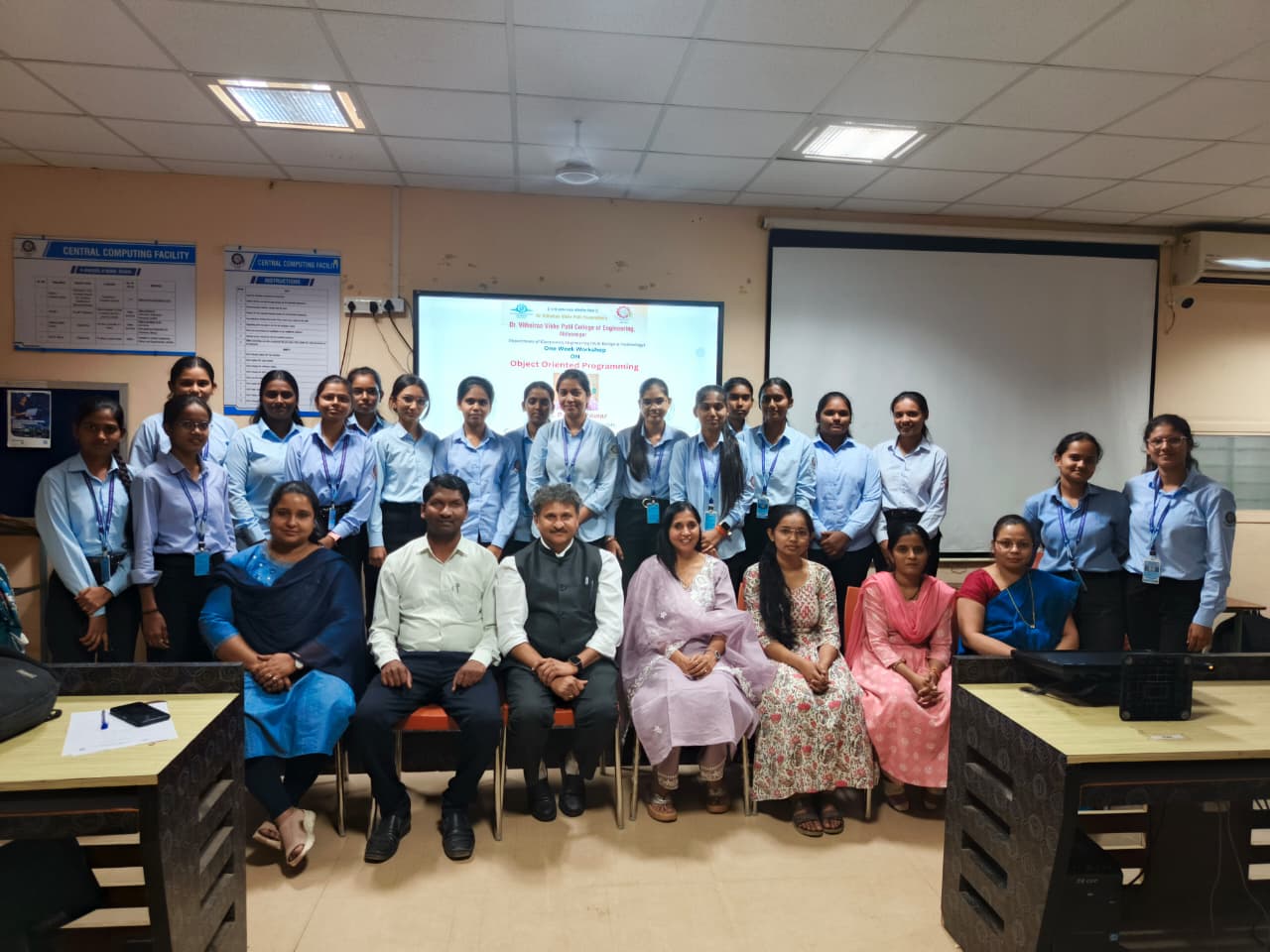
5 Days workshop on Object Oriented Programming.
- Objectives:
- Students will be able to design and implement OOP-based programs using an appropriate programming language (e.g., Java/C++/Python).
- Students will understand the fundamental concepts of Object Oriented Programming such as classes, objects, encapsulation, abstraction, inheritance, and polymorphism.
- Students will develop the ability to apply OOP principles in solving real-world problems.
- Students will gain hands-on experience in writing modular, reusable, and maintainable code.
- Students will understand the concept of constructors, destructors, access specifiers, and method overloading/overriding.
- Students will be able to implement file handling and exception handling using OOP concepts.
- Students will be able to design small-scale applications using OOP concepts.
- Students will gain confidence to apply OOP knowledge in academic projects and future software development tasks.
- Date of Conduction: 09/02/2026 to 13/02/2026
- Expert: Mrs. Prachi Pawar- Seed Infotech- Computer Vision Ahilyanagar
- Time: 10.00 AM to 05:00 PM
- Classes attended: SE students
- Number of students attended: 72
- Venue: CCF Lab
- Event In charge (VESA Co-ordinator): Prof..D.A.Ghanwat
- Outcome:
1. Students understood the basic principles of Object Oriented Programming including classes, objects, inheritance, polymorphism, abstraction, and encapsulation.
2. Students were able to write and execute OOP-based programs using the selected programming language.
3. Students developed the ability to apply OOP concepts to solve real-world problems.
4. Students improved their coding, debugging, and logical thinking skills through hands-on practice sessions.
5.Students gained knowledge of advanced concepts such as constructors, method overloading/overriding, exception handling, and file handling.
6. Students were able to design simple applications using OOPS principles